
Teaching and Learning in the Clinical Context
The TLC program is designed for current and/or aspiring supervisors/preceptors from all health disciplines to develop the foundational knowledge and skills needed to effectively teach learners in various clinical contexts. it includes eLearning modules and facilitated group learning sessions.
No events to show
Description
Teaching and Learning in the Clinical Context (TLC) is a 12-week virtual program with both self-paced, self-directed eLearning modules as well as facilitated group learning sessions.
The goals of the program are for participants to:
- Develop the foundational knowledge and skills needed to teach in the clinical context
- Recognize how to be adaptive clinical teachers, responsive to unique contextual and learner needs.
The program is practical and evidence-informed, enabling clinicians to successfully teach in the current and future health care climate.
***If you are a Scarborough Health Network (SHN) Physician please click here to register***
Additional Info
Self-paced, self-directed eLearning modules are completed by participants in between each facilitated synchronous session throughout the duration of the program.
Registration Closes: November 11, 2025
Dates
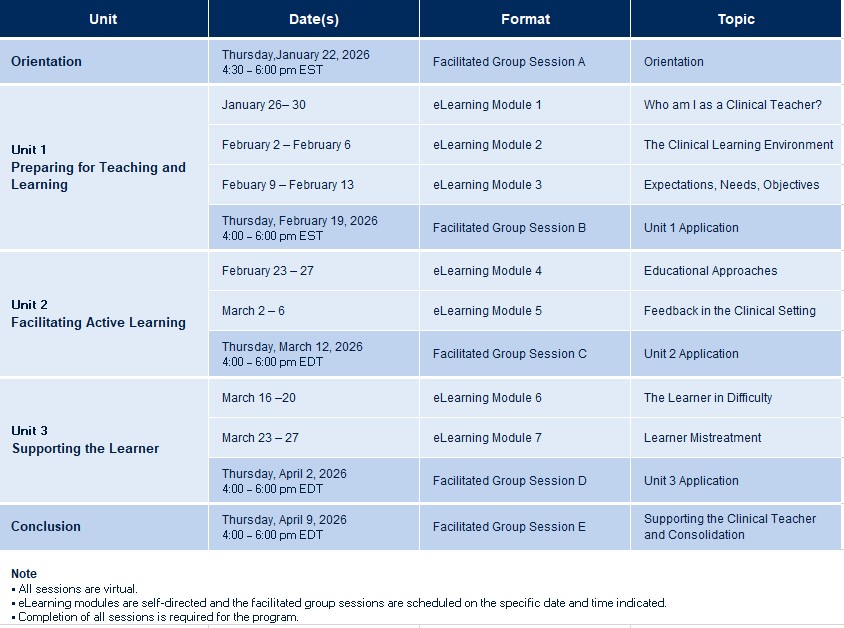
Program Details
For more information, please visit the TLC Program Page.
Event Details
Recommended Events
-
 1SepCFD members have exclusive access to innovative and responsive workshops, events and special rounds as well as many other benefits.
 -
 29SepThis Community of Practice for late career physicians is designed to support navigating and decision making by providing opportunities to share stories and personal perspectives. Expert panelists and speakers will also be featured for specific topics.
 -
25MarThe Centre for Faculty Development’s Teaching and Learning in the Clinical Context (TLC) program is designed for supervisors/preceptors to develop the foundational knowledge and skills needed to effectively teach learners in various clinical contexts. This iteration of the TLC program is uniquely contextualized for the Scarborough expansion and will build a community of support for those involved to connect about clinical teaching.
